Feminist Yoga Books
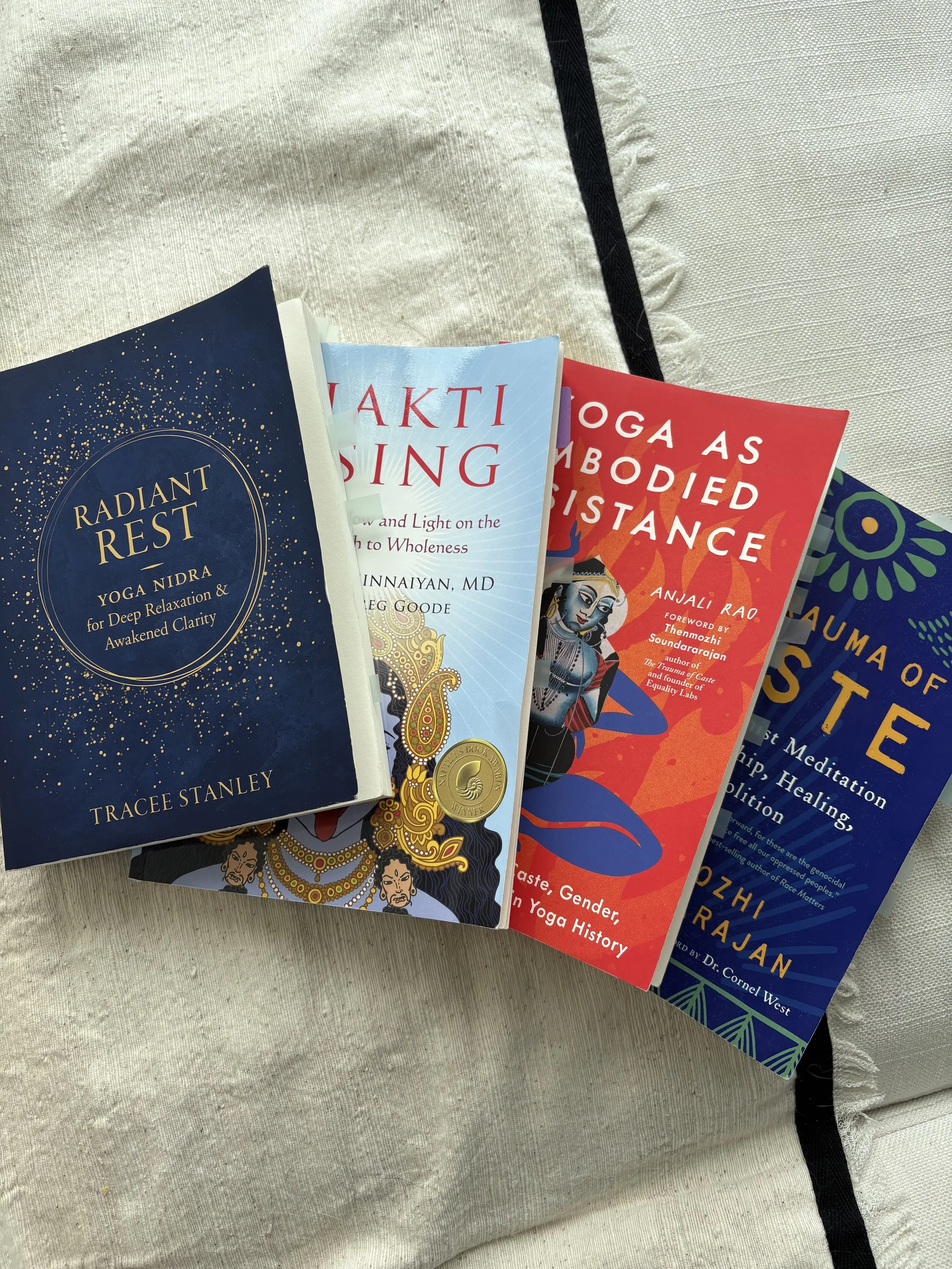
I enjoy reading books about feminism, and I also enjoy reading books about yoga. It’s not always the case that books about yoga have a feminist perspective, so I wanted to put together a feminist-friendly list of yoga books that I’ve recently read.
bell hooks defines feminism as a movement to “end sexism, sexist exploitation, and oppression.”
Feminism is not about being anti-male, because women are capable of sexist thinking, even when they might call themselves feminists or use the language of feminism. For more insight on the history of feminism and why it is important to apply an intersectional lens as feminists, Angela Y. Davis has discussed how the women’s movement in the US has been betrayed by race and class divides in her seminal work Women, Race, and Class, and Sophie Lewis’ Enemy Feminisms, a book that I recently read, also offers a historical look into anti-liberatory forms of western cis-feminism.
I was inspired to put this list together after reading a few duds that marketed themselves as a feminist yoga book, but in actuality offered a shallow and capitalistic understanding of feminism.
This is a random list. I read these books without planning to do a blog post on them. Some of the books market themselves as feminist. Some do not use the label and are not focused on politics, but are feminist in spirit in how they share yogic knowledge.
Trauma of Caste: A Dalit Feminist Feminist Meditation on Survivorship, Healing, and Abolition by Thenmozhi Soundararajan
“People in the West need to know that most of the spiritual, intellectual, and cultural products of South Asia are tainted by Brahminism. What may have offered you liberation and healing also causes caste-oppressed people to suffer. You don’t have to give up those practices or concepts, but the call is to be intentional and acknowledge the caste harm. Your faith is bound to the violence it sanctions.”
-Thenmozhi Soundararajan
“Hinduism was therefore India and India was only Hindu.”
- Azad Essa
I consider yoga a sacred space, but it is harmful to believe yoga is separate from politics, when it functions as the soft power behind the far-right Hindutva political agenda. Hindutva is a supremacist ethno-nationalist ideology that is fundamentally anti-Muslim.
Hindutva is the dominant form of Hindu nationalism in modern Indian politics, and its ideological playbook is similar to that of Israel. A good resource if you want to read further on that is Azad Essa’s book, Hostile Homelands: The New Alliance Between India and Israel, a gripping must-read.
Essa speaks of how “Hindutva had little to do with the practices or beliefs of Hinduism”, but was predicated on Hinduism as a “codified religion based on racial and doctrinal purity” (where upper caste Brahmins are at the top of social hierarchy), all the answers are found in the Vedas, and outsiders such as Muslims are threats to Hindu self-preservation.
It is therefore important for people who love the practice of yoga to educate themselves about caste apartheid that happens not just in India but among the diaspora, and to stand in solidarity with Dalits and caste abolition, because under Hindutva, yoga is used to justify racial and class stratification.
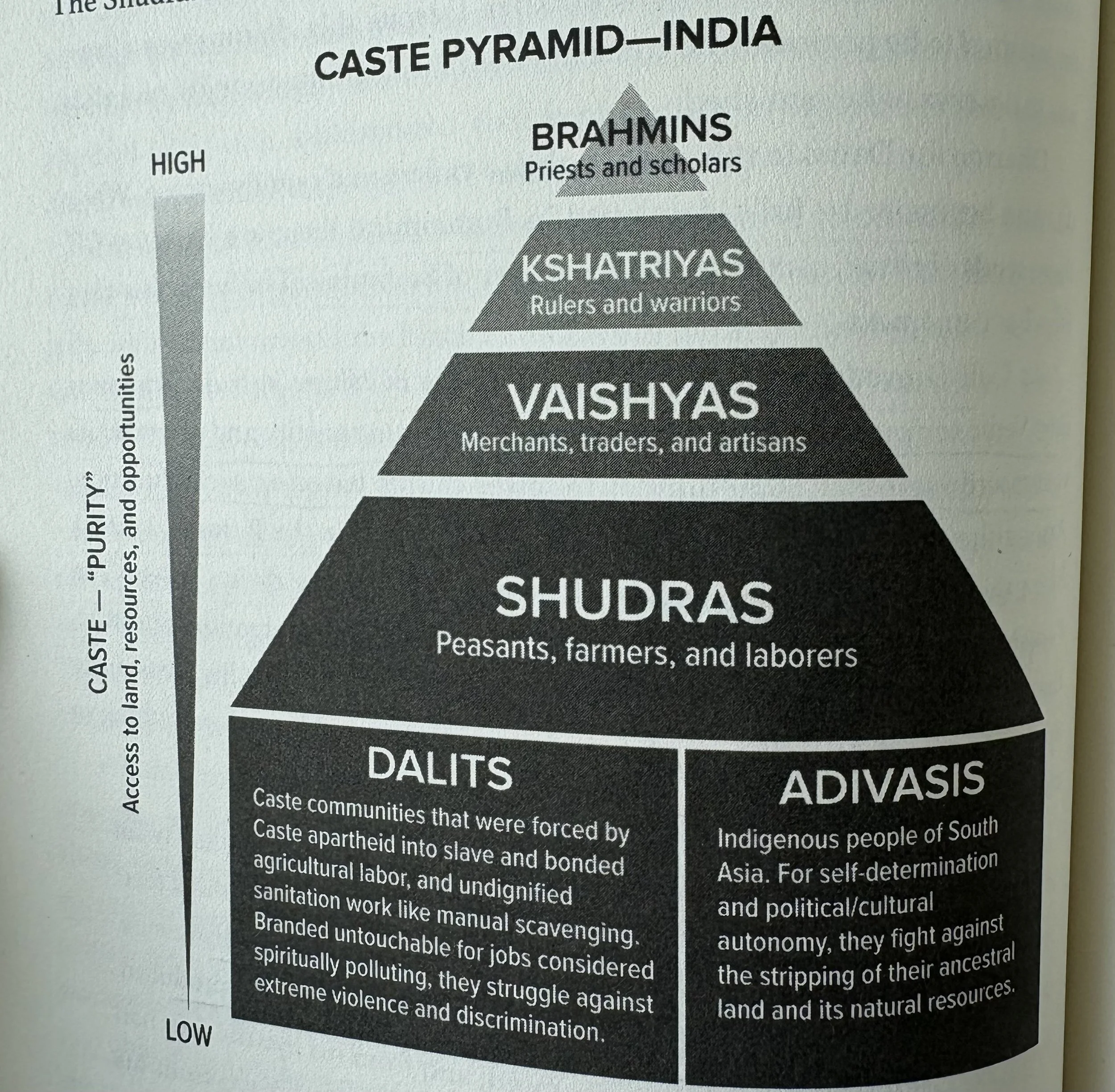
Thenmozhi Soundararajan’s book is a great place to begin your caste abolition journey. There are stats that show caste oppression: In every industry, Brahmins dominate, yet they represent only 5% of the Indian population. There are 166.6 million Dalits in India alone and they are at the bottom of the caste hierarchy. Known as untouchable, they call themselves Dalit, which means “broken” as a form of political identity.
It is one term that caste-oppressed may choose to go by, although it is not always the case. Some Dalits prefer to be known by their faith, as Bahujan, a Pali term meaning “the many” or “the majority” often found in Buddhism, Ambedkarite, after Dr. B.R. Ambedkar, or by their sub-caste. However, Soundararajan’s caste is where the origin of the English word “pariah” comes from, and they would not refer to themselves by their sub-caste.
Cultural claims about caste are dispelled throughout this book. Some of those cultural claims include downplaying the violence of caste (even using the term caste system can imply there are some positive benefits to this structure), focusing on how it is inaccurate or disrespectful to compare caste to Black slavery, or that caste was better before British imperialism.
The book structure mirrors the Four Noble Truths in Buddhism, sharing a glossary of terms and an amazing section that profiles Dalit ancestors including the mother of Indian feminism, Savitribai Phile, a caste-oppressed Shudra feminist, as well as Phoolan Devi, a bandit and outlaw member of parliament.
Additional Reading:
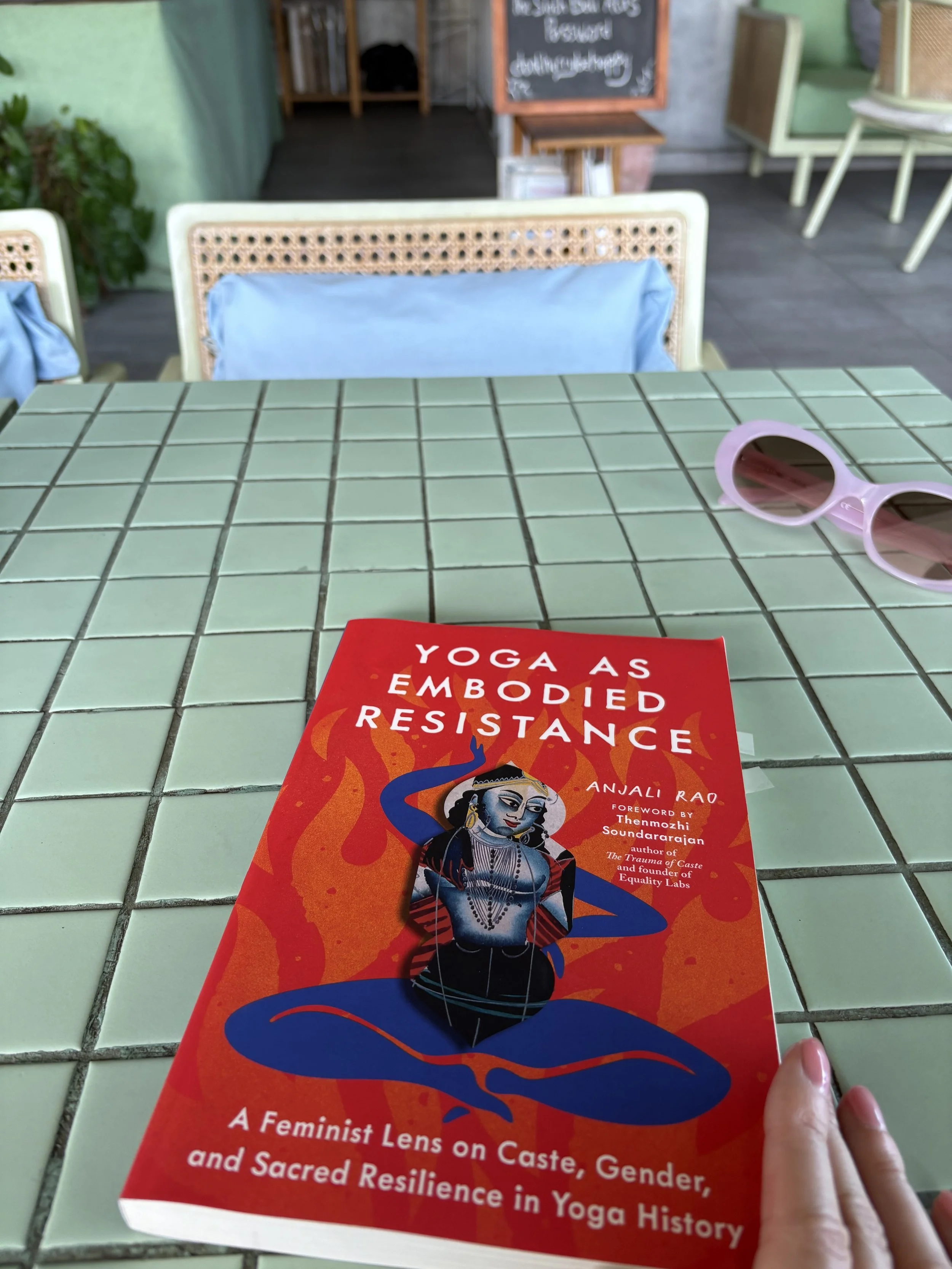
Yoga as Embodied Resistance: A Feminist Lens on Caste, Gender, and Social Resilience in Yoga History by Anjali Rao
“Yoga has the potentialto reduce physical, psychological, and spiritual suffering (dukka) and build community, but yoga spaces are a microcosm of dominant cultures everywhere and have been operationalized to maintain power constructs of caste, religion, race, class, and ability. Therefore, mere appreciation of a culture is not enough; we have to go one step further and discard the elements that have caused oppression, like caste and patriarchy.”
-Anjali Rao
We are often told in the west to honour the roots of yoga, but in doing so, are we perpetuating more violence? Being told and sharing statements like yoga is Hindu or Sanskrit is the only language of yoga are not innocent but carry political implications.
Similar to how Israel spreads misinformation, we do not have to fall for or concede to the far right when they deploy arguments commonly associated with progressive movements as a shield for them to justify ethnic cleansing and military violence.
Anjali Rao’s Yoga as Embodied Resistance debunks much of Hindutva’s claims on yoga. Rao is currently a Doctoral student pursuing her ph.D in Philosophy and Religion in the California Institute of Integral Studies, which is why this book is a well-researched work that looks at archaeology and history to show the plurality of the yogic tradition, the rise of the Brahmin orthodoxy, while uplifting figures that represent yoga’s heterodox strands that rejected and challenged Vedic authority held by the Brahmin caste.
One of the most powerful chapters debunks Hindutva claims on yoga as a Hindu practice that we in the yoga world have most likely already heard.
The roots of yoga are often said to come from pastoral Aryans who brought Indo-European languages (early Sanskrit) and Vedic culture to the land we know of today as India. There are theories that claim Aryans are India’s original inhabitants, the same as the people of the Harappan/Indus Valley civilization of the Bronze Age. Rao does a great job of poking holes into these theories from sharing the latest research into important differences between these two people.
An interesting tidbit was how, while the main script of the Harappan civilization remains undeciphered, scholars agree it is likely proto-Dravidian, not Sanskrit, in origin. Proto-Dravidian means it would be the ancestral language to Dravidian languages of today that include Tamil, Telugu, Malayalam, Kannada, Gondi etc.
As yoga practitioners, we may learn this history without knowing that Hindu nationalists (Hindutva) use these historical narratives in order to “promote ideals of Brahminical Hinduism, appropriating and erasing yoga’s connections to Buddhist, Sufi, Jain, and Tantric traditions in South Asia”, as Angana Chatterji succinctly puts it.
These early chapters by Anjali Rao dedicated to breaking down yoga’s history and deconstructing Hinduism are deeply invaluable for yoga practitioners who are aware of the wellness to fascism pipeline, and do not want to be unwittingly pulled in for that indoctrination ride.
Rao is focused on uplifting figures who challenge Brahminical orthodoxy during the Upanishadic, Puranic, Bhakti, and colonial time periods. You get a good sense of the pluralistic threads of yoga through these radical figures. The scholar-ascetic Sulabha’s debate with King Janaka in the Upanishadic epic, the Mahabharata, shows the fluidity of gender and how “women were always a part of yogic traditions.”
Radha shows the power of the divine feminine, and of how a tribal cowherdess icon becomes absorbed into the Hindu pantheon as a goddess-consort during the rise of Bhakti after the Vedic period. Bhakti, the path of loving devotion to a personal deity.
Akka Mahadevi, 12th century Bhakti poet, defied gender and caste norms with her devotion to Shiva, while Piro, a Muslim courtesan from Punjab in the 12th century, lived in a radical sect based on Sufi, Sikh, and Vedantic thought known as Gulabdasi.
While yoga is often associated with Brahmanical orthodoxy, this book complicates and radicalizes the history and figures of yoga we should know about.
Additional Reading:
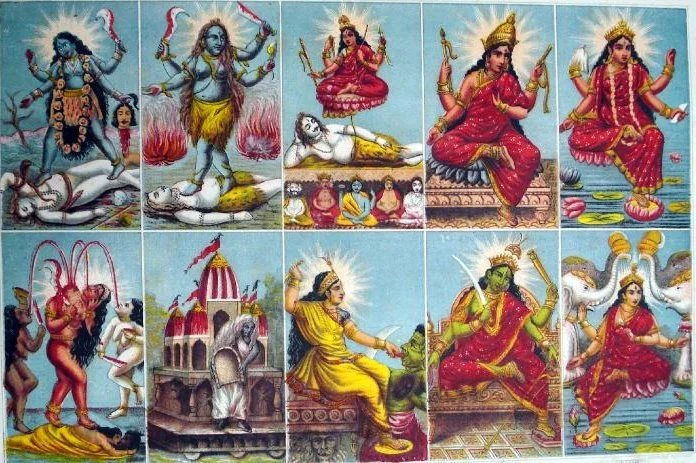
Top: Kali, Tara, Tripura Sundari, Bhuvaneshvari, and Bhairavi
Bottom: Chhinnamasta, Dhumavati, Bagalamukhi, Matangi, and Kamala
“The images of the Mahavidyas are meant to jar us out of complacency and to allow us to see that nothing escapes the Divine—our shadows are as much a part of it as the light. This is the way of tantra, which leads us to light through our darkest shadows, our worst fears, and our greatest pain.”
-Kavitha M. Chinnaiyan
“According to Tantric philosophy, the Mahavidyas are ten aspects of the divine feminine that manifest as distinct cosmic personalities or wisdom goddesses.” We can work with them for liberatory self-knowledge. There are a fair number of goddess books out there, and I very much enjoyed Kavitha M. Chinnaiyan’s take where the 10 wisdom goddesses are correlated to the 10 yamas and niyamas.
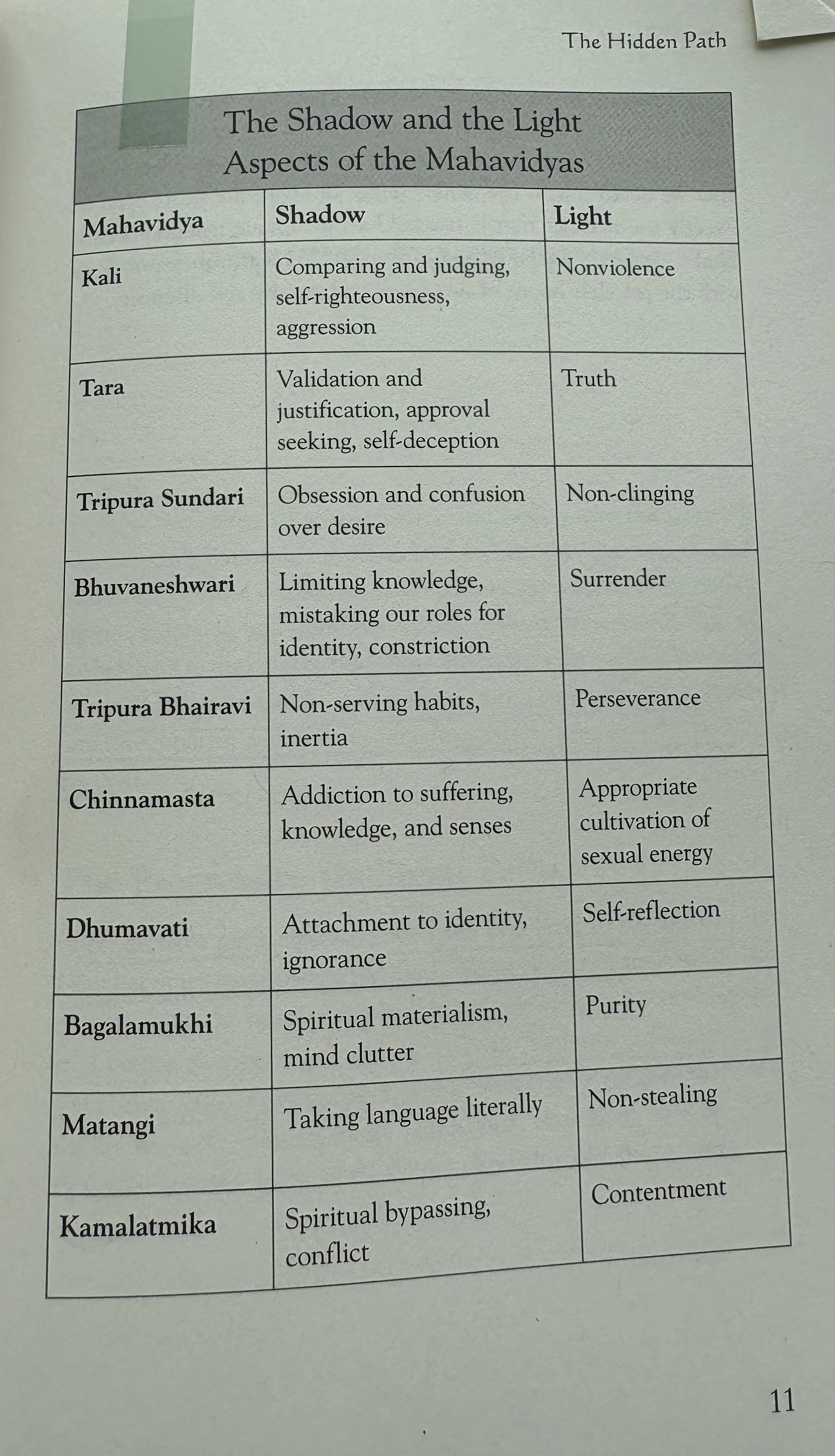
Shakti, as the “life essence of creation” is present within us and this includes her shadows and her light. As someone who believes in shadow work for self-knowledge, this book was a great exploration into the aspects of the divine feminine that range from scary to sweet.
The 10 wisdom goddesses are listed in a specific order, as are the yamas and niyamas. What can be confusing is that you may expect those to be two lists where, for example, Tripura Sundari as the third wisdom goddess would correlate to the third yama, cultivation of sexual energy or brahamcharya, but Chinnamasta, the sixth wisdom goddess is listed instead.
This is a good resource that requires note-taking, if you are someone like me who gets easily lost when it comes to lists and definitions, but I also liked it because it was very educational. Yogic concepts such as the vasanas, granthis, gunas, doshas, are explained, and there are helpful drawings and tables. Each chapter begins with a drawing of the goddess and details her appearance and symbolic objects.
This book does not overplay its hand on leaning into feminism. Its early chapters hinted at the possibility that this book would discuss current examples along with ancient teachings, as it stated how learned yoginis were “gradually overshadowed by the establishment of patriarchy” and also did not agree with the assumption that the feminine is “soft” or “useless.” However, this book does not really go into social issues of today, although it would have been interesting to explore, for example, using Chinnamasta and brahamcharya again, how we can understand sexual violence or the purity myth women face through these concepts.
Additional Reading
Radiant Rest: Yoga Nidra for Deep Relaxation and Awakened Clarity by Tracee Stanley
“Yoga nidra connects us to the universal energy of the Mother, which includes the feminine qualities of nurturing, support, rejuvenation, receptivity, and surrender. If we can remember this great Mother Teacher, Mataji, or the energy of the Universal Mother at the beginning of our yoga nidra practice, we honor a lineage of teachers, including our own ancestral mothers even if we do not know their names.”
-Tracee Stanley
I recently finished Tenzin Wangyal Rinpoche’s The Tibetan Yogas of Dream and Sleep: Practices for Awakening (not me shoehorning another book as I am recommending a book), and the more that I learn about dream yoga or yoga nidra, the more that I find this practice a welcome space to connect with the feminine. Gyuma Chenmo is the dream goddess (dakini) in the Tibetan Bön tradition. And in Radiant Rest, Tracee Stanley speaks on the Goddess Yoga Nidra as a Divine Mother.
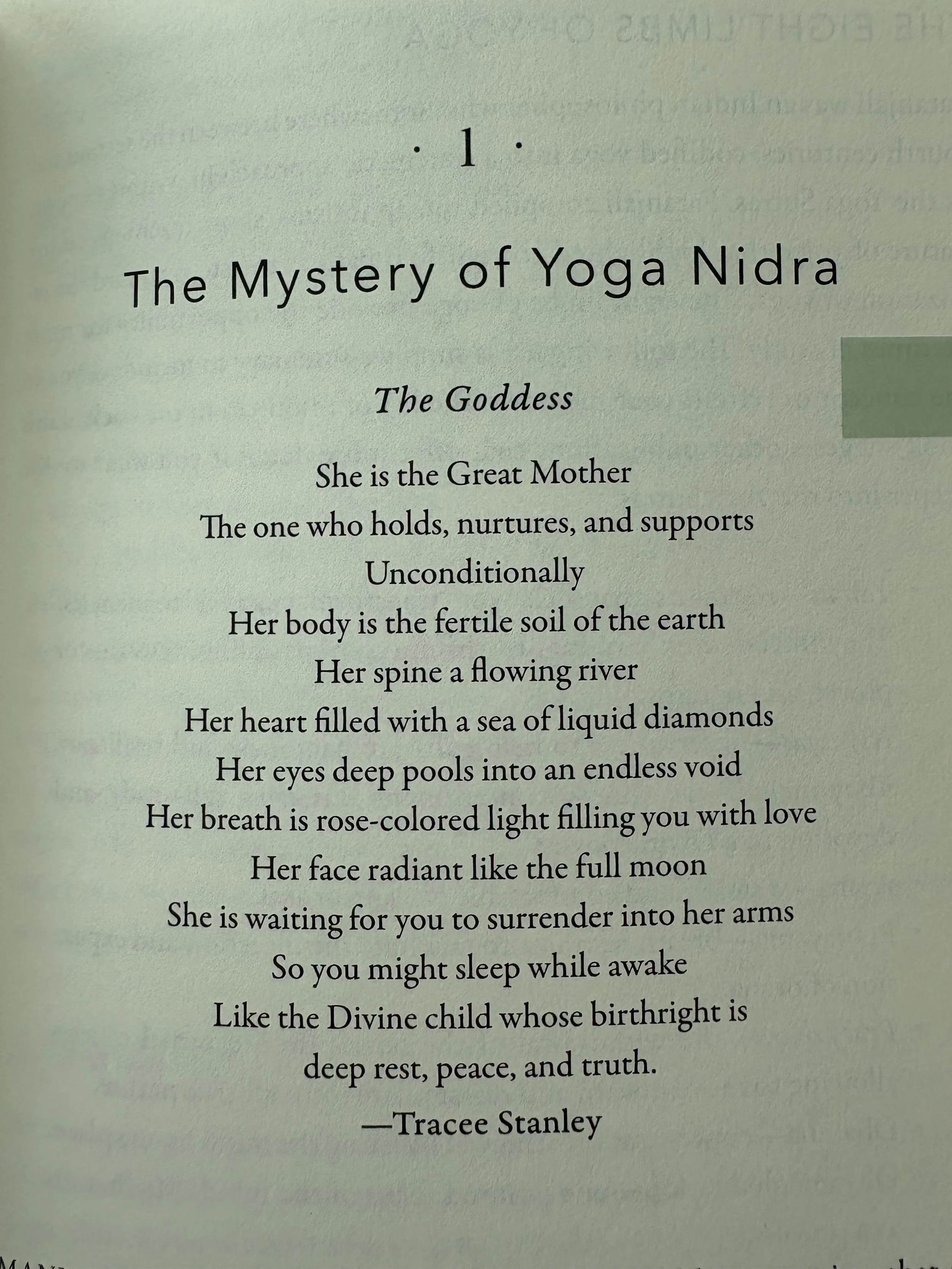
If you are interested in yoga nidra, I would highly recommend this book, especially in its physical copy with its midnight-blue velvet cover and goldfoil embossing, and lovely paper. Sorry for waxing poetic, but it’s to encourage the book publishers to continue making books pretty. Aside from its reverence for the Divine Mother, Radiant Rest is a how-to book if you’re looking for yoga nidra scripts and self-inquiry journaling prompts. But it’s not a dry book. I love how Stanley shares her creative writing, including “The Goddess” poem or “Householder’s Prayer,” which I’ve both read in my yin yoga classes.
As a yoga teacher and student, this book is one of my go-to resources when I am seeking inspiration for my classes.
Additional Reading: