
Use Both Aesthetic Alignment and Functional Alignment
How useful is it to look at your body when you are getting into a yoga pose?
Most yoga classes teach aesthetic alignment, which means that a yoga pose should look a certain way, even when there is no functional benefit behind it. Functional, in this case, meaning there is no scientific evidence to back up the health or safety claims that are made for such alignment cues.
To an extent, it is the most accessible way to guide the body into a pose by focusing on how it looks. All you need is a mirror and perhaps consensual hands-on assistance. Most teachers learn how to teach yoga asana through aesthetic alignment, because it provides us with a general framework to teach yoga poses that will work for most bodies.
Since this approach focuses on how it looks, we are teaching an archetype. We learn about options for people who cannot do a pose, such as if they have contraindications (health or medical condition that may make a certain movement harmful), pre-existing injuries, or are pregnant.
While we are trained to provide responsible alternatives, the look of the pose is prioritized above all else. This isn’t necessarily a bad thing if the student can do the pose without pain. As well, beauty can be a powerful motivator in keeping a consistent yoga asana practice. It can certainly be empowering to recreate these graceful shapes with your body!
However, aesthetic alignment can be limiting when we bring safety into the conversation.
Safety and Purpose: Fundamental Differences Between Aesthetic and Functional Alignment
When I took my first yin yoga training with Bernie Clark in 2020, it was my introduction to the terms “aesthetic alignment” and “functional alignment.” Yin yoga is rooted in functional anatomy, where the visual look of a pose will never supersede how it feels for the student.
Functional alignment is about how it feels, and whether the intended target area of a yoga pose is being stretched for a student. This means that if you perfectly nail what the pose looks like but remain disconnected from how it feels, the practice has not started. We want students to feel the intended target area, and if there is a conflict between the feeling and the look, we want students to go with what it feels like. This means the yoga pose may look vastly different in student bodies, and there is nothing we, as teachers, need to correct.
I share many of Bernie’s pithy sayings in my yin yoga class, and a recent one I discovered in researching for this blog post, was how he said there are no universal cues. This hit me hard, and it’s another way of understanding that general alignment cues are not universal alignment cues, and it is most valuable for yoga practitioners to focus on understanding our individual neutrality, which then becomes your space to create safety in the body.
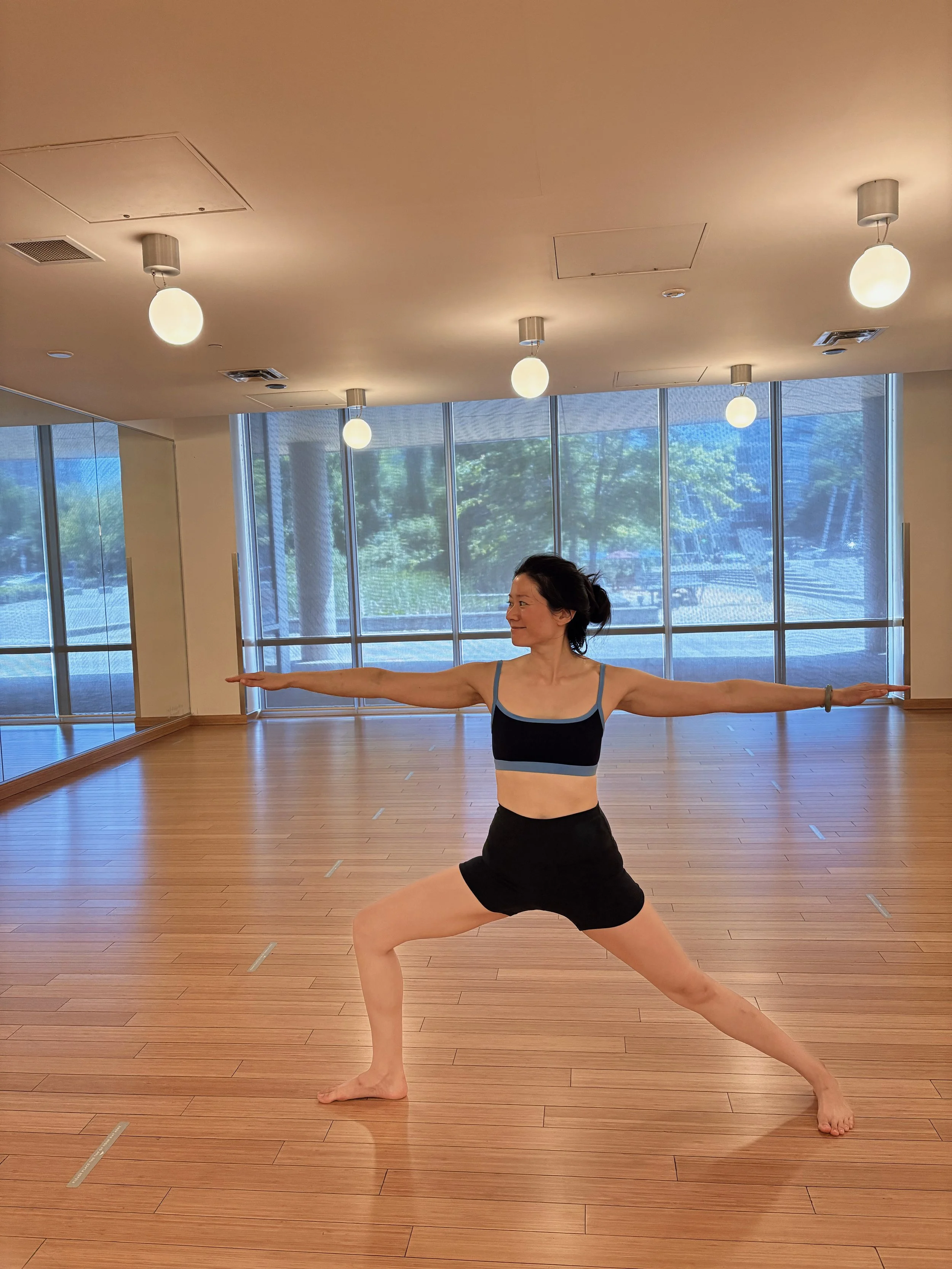
Let’s take a look at Virabhadrasana 2 (Warrior 2) as an example.
“Front knee stacked on top of the ankle.”
“Front knee pointing forward, not in or out.”
These are common aesthetic cues. Oftentimes, we are told that stacking joints is most stable for the first cue. And for the second cue, our knee may be pointing in because our inner thigh muscles are tight which pulls our knee inward, and our outer hip muscles are not engaging, so we instruct students to point the knee straight forward. In this context, it is within our power to do something about it, and work on strengthening parts of the body that are weak and not on.
A functional approach to cuing Warrior 2 would not instruct with these cues, or if they do offer these cues, they would not enforce them when they immediately spy students with their knee going in or out, rather than straight forward.
This is because we are aware that for some students, they will not be able to stack the knee on top of the ankle and have the knee pointing directly forward.
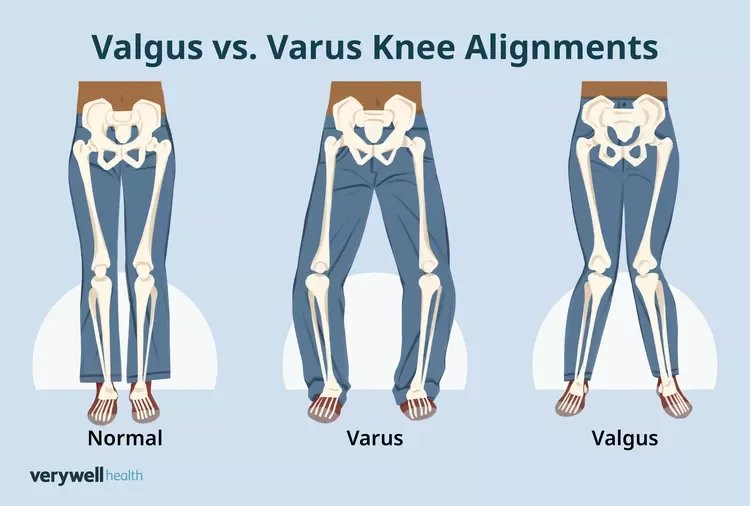
Illustration by Joules Garcia for Verywell Health
Students with a valgus knee will have their knee turn in (“knock knee”), while students with a varum knee will have their knee turn out (“bow legged”), even when their ankle and foot is neutral.
If the foot is neutral, there may be no need to correct this knee condition, and in fact, correcting this condition may lead to pain or injury, as it can take students out of their neutral orientation.
If the foot is turned out (pronation) and the knee is neutral, you could correct the valgus condition. When this correction is offered, students should also be given cues that help them strengthen their abductors (inner thigh muscles), external hip rotator muscles, and lateral hamstring muscles.
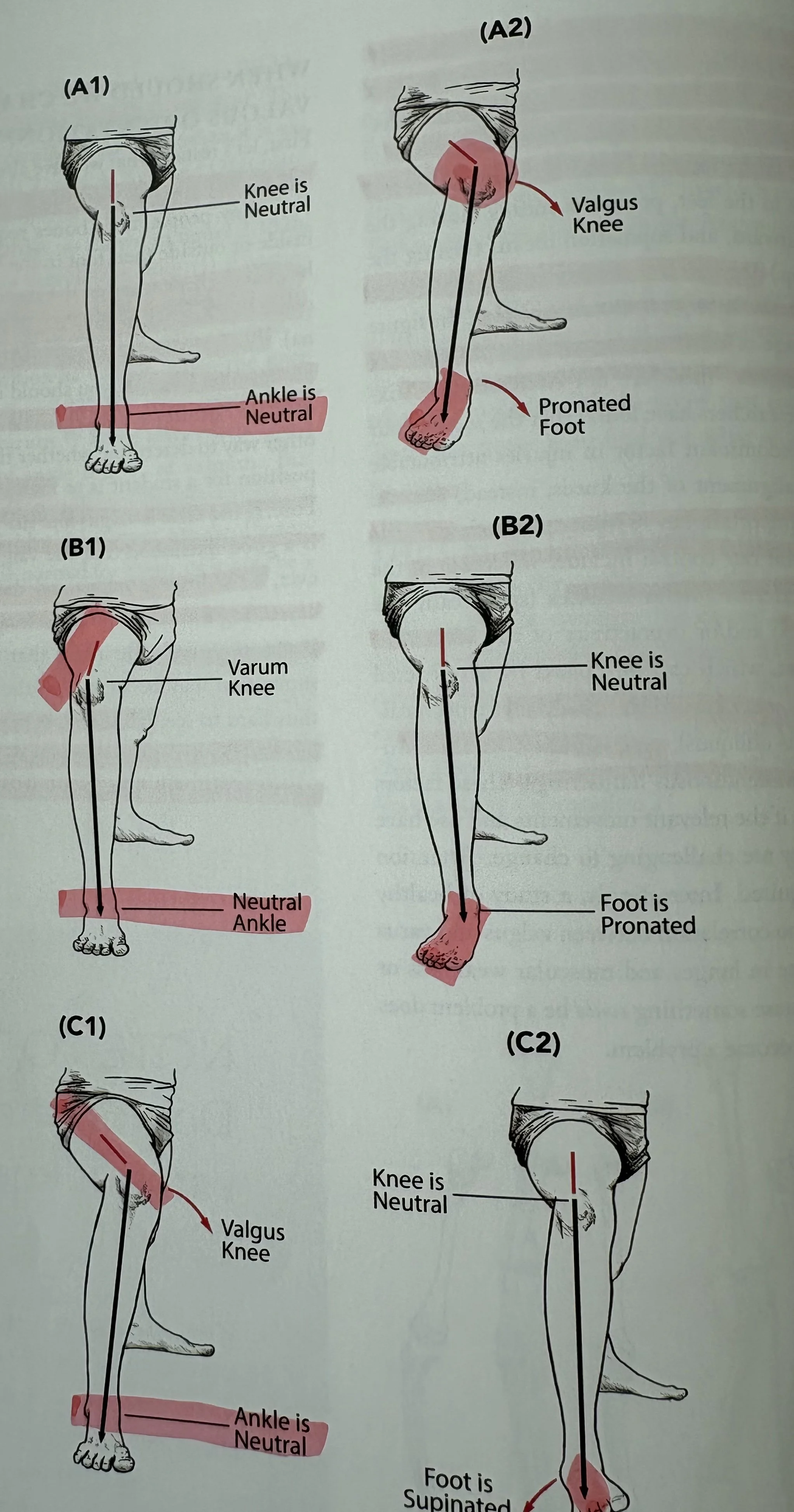
Your Body, Your Yoga by Bernie Clark
Is One Alignment Style Better Than the Other?
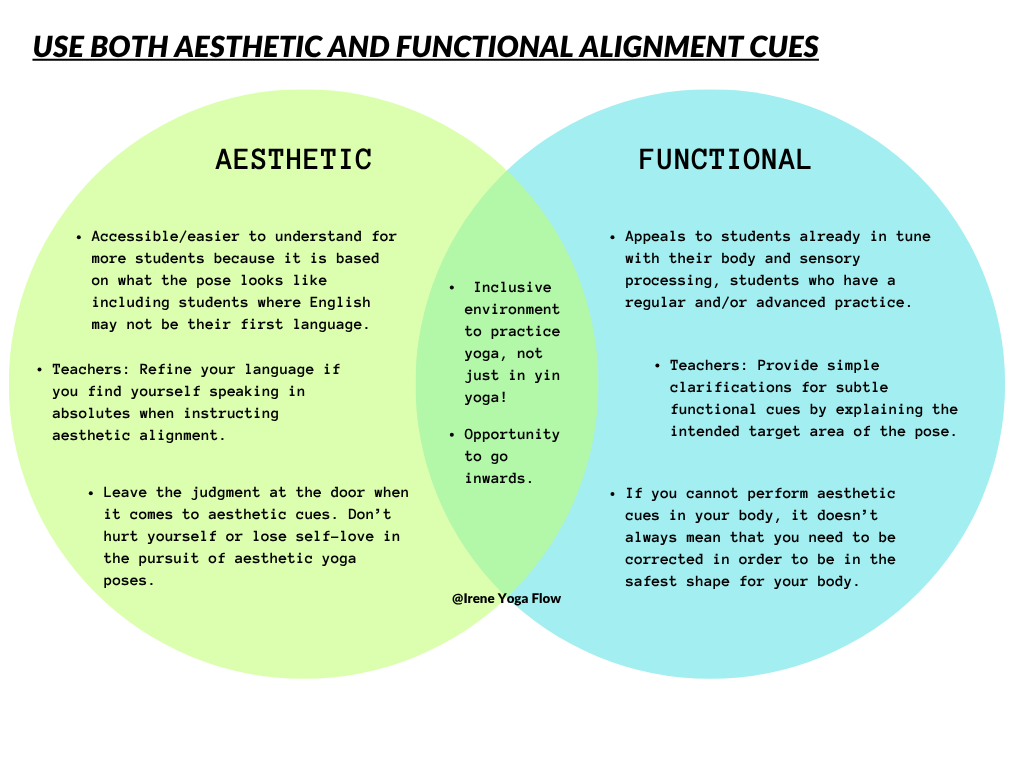
There is space for both alignment styles.
Aesthetic alignment can be helpful for beginners because the cues are focused on the physical appearance of a pose. There is no room for interpretation, because it is based on what we see, more or less. In trauma-aware yoga, providing more subtle cues that functional alignment can tend to prioritize (“focus on how it feels”) may not be helpful for students who may be disconnected from their body due to trauma. Aesthetic cues are also unadorned by flowery language, which can be supportive for students where English may not be their first language. For myself, it is also nice to just listen to the teacher and go on the journey they have designed for class!
Yet, aesthetic alignment can be exclusive as well. I find aesthetic alignment can bring out a militant, often pedantic streak in teachers. It can be too prescriptive, and teachers could make students feel there is something wrong with them when their body can’t perform the cue. To the extreme, a teacher can lack compassion for a student, misinterpreting a student’s inability to practice the cue as not listening or being lazy.
I have noticed it in myself where I have offered suggestions to students based on how it looks, because I associate how it looks with what is correct, but also safe. What I do to soften this impulse is to explain when something is done for aesthetic purposes. I also tie it back to proprioception and interoception. More on that in the next section.
Functional alignment can be thought of as more advanced. It truly asks our students to take accountability for their own practice. Students who already have a yoga practice, are not only comfortable but adept at listening to their bodies may appreciate and value functional alignment cues more. Understanding functional anatomy also encourages teachers to be more inclusive and nuanced in how they hold space, offer cues without being didactic or speaking in absolutes, and what they choose to correct in students.
Taken to the extreme, however, functional alignment cues can sound wishy-washy. See how it feels can be so boundless that I do worry at times if students may feel unsupported by such a cue, or lose faith in my ability to guide them. To counteract this, I explain more about the intended target area and affirm they have the power to choose to explore today or not.
I have also noticed teachers who are aware of functional alignment can be dismissive towards hypermobile folks, and this is falling into the moral superiority trap too. Functional alignment doesn’t cast a judgment on people with less or more mobility. We should not automatically judge someone who is hypermobile for having an unsafe yoga practice or showing off, as this is projection. In the case of hypermobility due to skeletal variation (how their bones are set), it depends on their range of motion. Whether you have less or more of it will determine what your normal is to stretch so you don’t atrophy. However, in cases where hypermobility is caused by injury or genetic differences in fascia, students should be cautious.
It is clear that both alignment styles can be used to be more inclusive or to be exclusive.
Proprioception and Interoception
I was doing some (re)reading on sensory processing from my yin yoga and sound healing manual, and was struck by how proprioception and interoception are analogous to aesthetic and functional alignment, and understanding this can promote appreciation for both alignment styles.
Proprioception: Your body’s ability to sense movement, action, and location.
Interoception: Your ability to understand and feel what’s going inside your body.
Proprioception is being aware of your body in space. It prevents you from walking into things as you go about your day. Similar to aesthetic cues, do you know what it looks like to stretch your arms to the side, arranged in one horizontal line?
Interoception is knowing when you are hungry or need to pee; you can identify your body’s internal senses and related emotions. In yoga, it is important to discern the difference between discomfort and pain in the body, and interoception helps us with this knowing. Functional cues focus on stretching the intended target area, and while there may be discomfort, we never instruct students to stay in a pose if it becomes painful. Our brains can be over or under-responsive to the signals that we receive from our body, so we can either be overly sensitive, or unable to recognize and interpret these signals.
Both proprioception and interoception are needed for us to process sensory information, and like aesthetic and functional alignment, using both can give us a more complete picture of what is going on in our body when we practice asana. That way, we can make wiser choices about how we want to move and how to use our energy.
Additional reading: